

The window sticker, also known as the Monroney Label, holds all the details about your Audi. For many owners and buyers, this label can feel dense and overwhelming. It lists standard features, optional packages, fuel economy, safety ratings, and more, making it easy to overlook or misinterpret important information.
This guide breaks down the Audi window sticker section by section, showing what each line represents and why it matters. Understanding it ensures you know exactly what your vehicle offers and helps you make informed decisions.
What Will You Find on an Audi Window Sticker
A typical Audi window sticker is organized into several key sections:
| Section | What It Contains |
|---|---|
| Header | Vehicle identification and summary information |
| Standard Features | Equipment included with the base trim level |
| Optional Equipment | Factory-installed packages and individual options with pricing |
| Fuel Economy | EPA-estimated MPG for city, highway, and combined driving |
| Safety Ratings | Crash test ratings and safety features |
| MSRP Calculation | Base price, option costs, destination charge, and total MSRP |
| Vehicle Specifications | Engine, transmission, drivetrain, and other technical details |
| Warranty Information | Basic and powertrain warranty coverage |
| Footer | QR codes, barcodes, and legal disclaimers |
← Scroll horizontally to see more →
Section 1: The Header
The header appears at the top of the window sticker and contains basic identifying information about the vehicle.
Vehicle Identification Number (VIN)
The 17-character VIN is displayed prominently, usually at the top of the sticker. This is the unique identifier for your specific Audi.
What to Look For
- VIN matches the vehicle: Always verify that the VIN on the sticker matches the VIN on the dashboard and door jamb.
- Digit 10 (Model Year): Confirms the vehicle’s model year (e.g., R=2024, S=2025, T=2026).
- Digit 11 (Assembly Plant): Indicates where the vehicle was built (4=Ingolstadt, N=Neckarsulm, M=Mexico).
Model and Trim Level
The sticker clearly states the model (e.g., Audi Q5, Audi A4) and trim level (e.g., Premium, Premium Plus, Prestige).
Why It Matters
- The trim level determines which features are standard vs optional.
- Higher trim levels (Prestige) typically include features that are optional on lower trims.
- Knowing the trim helps you understand the baseline configuration before optional packages are added.
Model Year
The model year is displayed prominently, often near the VIN or model name.
Important Note
The model year may differ from the calendar year of manufacture. For example, a 2025 model may have been manufactured in 2024. This is normal and reflects the automotive industry’s model year cycle.
Section 2: Standard Features
The standard features section lists all equipment that comes included with the base trim level—before any optional packages are added.
How to Read This Section
Standard features are grouped by category to make them easier to review. Each category highlights included equipment at no extra cost, helping you quickly understand what comes with the vehicle and how different trims compare in terms of built-in features.
Exterior Features
| Feature | What It Means |
|---|---|
| LED Headlights | Standard lighting technology |
| Power Tailgate | Hands-free or power-operated trunk/hatch |
| Panoramic Sunroof | Glass roof extending over front and rear seats |
| Heated Mirrors | Exterior mirrors with defrost function |
← Scroll horizontally to see more →
Interior Features
| Feature | What It Means |
|---|---|
| Leather Seating Surfaces | Standard upholstery material |
| Heated Front Seats | Seat heating for driver and passenger |
| Three-Zone Climate Control | Separate temperature zones for driver, passenger, and rear |
| Power-Adjustable Front Seats | Electric seat adjustments with memory settings |
← Scroll horizontally to see more →
Technology Features
| Feature | What It Means |
|---|---|
| Audi Virtual Cockpit | Digital instrument cluster replacing traditional gauges |
| MMI Touch Display | Central infotainment screen |
| Apple CarPlay / Android Auto | Smartphone integration |
| Wireless Charging | Inductive charging pad for compatible devices |
← Scroll horizontally to see more →
Safety Features
| Feature | What It Means |
|---|---|
| Forward Collision Warning | Alerts driver to potential front-end collisions |
| Automatic Emergency Braking | Applies brakes if a collision is imminent |
| Blind Spot Monitoring | Alerts to vehicles in adjacent lanes |
| Rearview Camera | Backup camera with guidelines |
← Scroll horizontally to see more →
Why This Section Matters
- Helps you understand what features are already included without additional cost.
- Prevents you from overpaying for “upgrades” that are actually standard equipment.
- Establishes the baseline for comparing trim levels.
Section 3: Optional Equipment
This is one of the most important sections for verifying factory options. It lists every package and individual option added to the vehicle, along with their individual costs.
Packages
Packages bundle multiple features at a discounted price compared to selecting them individually.
How to Read Package Listings
| Package Name | Typical Contents | Cost |
|---|---|---|
| Prestige Package | Matrix-design headlights, head-up display, upgraded leather, ambient lighting, and advanced audio | $5,000–$8,000 |
| S line Sport Package | Sport bumpers, sport seats, unique wheels, S line badging | $1,500–$2,500 |
| Driver Assistance Package | Adaptive cruise control, lane keep assist, intersection assist, parking assist plus | $1,500–$2,500 |
| Warm Weather Package | Ventilated front seats, rear manual sunshades | $1,000–$1,500 |
| Black Optic Package | Gloss black exterior trim, unique black wheels | $1,000–$2,000 |
← Scroll horizontally to see more →
What to Look For
- Package name: Confirms which bundled options were factory-installed.
- Package cost: Shows what the original buyer paid for the bundle.
- Description: Explains what features are included in the package.
Individual Options
Standalone features that can be added without purchasing a full package.
| Individual Option | Typical Cost | Description |
|---|---|---|
| Bang & Olufsen Sound System | $1,000–$5,000 | Premium audio with distinctive aluminum speaker grilles |
| Adaptive Air Suspension | $2,000–$4,000 | Electronically controlled air suspension with adjustable ride height |
| Sport Differential | $1,500–$2,500 | Active torque distribution between rear wheels (S/RS models) |
| 21” Audi Sport Wheels | $1,000–$2,000 | Larger diameter wheels with a unique design |
| Heated Steering Wheel | $200–$400 | Steering wheel heating element |
| Panoramic Sunroof | $1,000–$1,500 | Glass roof (if not standard on the trim) |
← Scroll horizontally to see more →
Port-Installed Accessories
Items added at the port of entry before the vehicle reaches the dealership. These appear in the optional equipment section as well.
| Accessory | Typical Cost | Description |
|---|---|---|
| All-Weather Floor Mats | $200–$300 | Rubber floor liners for all-weather protection |
| Carbon Fiber Mirror Caps | $500–$1,000 | Replacement mirror housings |
| Roof Rack Crossbars | $400–$600 | Aerodynamic crossbars for roof-mounted cargo |
| Paint Protection Film | $500–$1,500 | Clear film applied to high-impact areas |
← Scroll horizontally to see more →
Why This Section Matters
- Verification: Confirms exactly which packages and options were factory-installed.
- Value assessment: Helps you determine if the vehicle has high-value options that justify a higher price.
- Negotiation leverage: Provides documentation if the seller claims options that aren’t present.
Section 4: Fuel Economy (EPA Estimates)
This section displays the official EPA fuel economy ratings for the specific vehicle configuration.
How to Read Fuel Economy Information
Reading fuel economy information can be hard for several people as they might not be familiar with it. Each of them has different information and usage, to make it easier, you can check the table below.
| Rating | What It Means |
|---|---|
| City MPG | Estimated fuel economy in stop-and-go urban driving |
| Highway MPG | Estimated fuel economy at steady highway speeds |
| Combined MPG | Weighted average of city and highway estimates |
| Annual Fuel Cost | Estimated yearly fuel expense based on average driving and fuel prices |
← Scroll horizontally to see more →
Important Notes
- EV and Hybrid Models: For e-tron models, this section shows MPGe (miles per gallon equivalent) and electric range.
- Actual Mileage May Vary: EPA estimates are for comparison purposes; actual fuel economy depends on driving habits, conditions, and vehicle maintenance.
- Drivetrain Impact: Quattro AWD models typically have slightly lower fuel economy than front-wheel-drive versions.
Section 5: Safety Ratings
This section displays crash test ratings and safety equipment information.
What to Look For
On the window sticker, you can examine the complete information on the NHTSA’s safety ratings to make sure that the vehicle is fully safe to be bought and driven.
NHTSA Ratings (National Highway Traffic Safety Administration)
- Overall Rating: 1 to 5 stars.
- Frontal Crash: Driver and passenger ratings.
- Side Crash: Front and rear passenger ratings.
- Rollover: Stability and risk assessment.
IIHS Ratings (Insurance Institute for Highway Safety)
Good, Acceptable, Marginal, or Poor ratings for:
- Moderate overlap front
- Side impact
- Roof strength
- Head restraints and seats
Safety Features List
The sticker also lists standard safety equipment, including:
- Airbags: Number and location.
- Stability Control: Electronic stability control (ESC).
- Crash Avoidance: Automatic emergency braking, forward collision warning, etc.
Section 6: MSRP Calculation
This section shows the price breakdown that adds up to the total Manufacturer’s Suggested Retail Price.
Components of MSRP
Do you know that MSRP has different components? On the window sticker, you’ll be able to see the complete MSRP components that influence the price.
| Component | Description |
|---|---|
| Base Price | Cost of the vehicle with standard equipment for the chosen trim level |
| Optional Equipment Total | Sum of all factory-installed packages, individual options, and port-installed accessories |
| Destination Charge | Non-negotiable fee for shipping from the factory to the dealership |
| Total MSRP | Base Price + Optional Equipment + Destination Charge |
← Scroll horizontally to see more →
How to Read the Pricing Breakdown
The base price is the starting cost of your Audi before any options or packages are added. It reflects the trim level you choose, with higher trims including more built-in features, technology, and premium upgrades.
Base Price Example
- 2024 Audi Q5 Premium: $45,000
- 2024 Audi Q5 Premium Plus: $50,000
- 2024 Audi Q5 Prestige: $55,000
Optional Equipment Total Example
This section shows the combination of all added options and packages. It includes upgrades like premium audio, driver assistance features, and design enhancements–which could increase the vehicle’s final price compared to its basic trims.
| Option | Cost |
|---|---|
| Prestige Package | +$6,500 |
| S line Sport Package | +$1,800 |
| Bang & Olufsen Sound | +$1,200 |
| Total Options | $9,500 |
← Scroll horizontally to see more →
Destination Charge Example
The destination charge is a fixed fee set by the Audi manufacturer to cover the transportation fee from the factory to the dealership. It applies to every vehicle and does not change based on trim level or optional equipment.
- A3, Q3: $1,095
- Q5, A4, A5: $1,195
- Q7, Q8, A6, A7, A8, e-tron GT: $1,295
Total MSRP Calculation
The total MSRP is the final price of the car that was suggested by the manufacturer by combining the base price, optional equipment, and destination charge. It applies to every vehicle and does not change based on trim level or optional equipment.
| Component | Amount |
|---|---|
| Base Price | $45,000 |
| Optional Equipment | +$9,500 |
| Destination Charge | +$1,195 |
| Total MSRP | $55,695 |
← Scroll horizontally to see more →
Why This Section Matters
The pricing breakdown is more than just a number; it provides the vehicle’s clear records of its original value, how it will depreciate over time, and how it should be assessed before putting it on sale, trade-in, or insurance purposes.
- Original Value: Shows exactly what the vehicle cost when new.
- Depreciation Baseline: Used to calculate how much value the vehicle has lost.
- Insurance Valuation: Reference for agreed-value policies and total loss claims.
- Resale Documentation: Demonstrates original configuration and value to potential buyers.
Section 7: Vehicle Specifications
This section shows the vehicle’s complete specifications, including core mechanical and technical details. Checking the vehicle’s complete specifications helps to understand the performance, comparing different trims, and assessing the maintenance needs.
Engine Specifications
You can examine the complete vehicle specifications information, like the engine type, size, horsepower, torque, fuel efficiency, and driving characteristics, based on the selected engine configuration.
| Detail | What It Means |
|---|---|
| Engine Type | 2.0L 4-cylinder turbo, 3.0L V6, 4.0L V8, etc. |
| Horsepower | Power output (e.g., 261 hp) |
| Torque | Rotational force (e.g., 273 lb-ft) |
| Fuel Type | Premium gasoline, diesel, and electric |
← Scroll horizontally to see more →
Transmission Specifications
This section explains the type of transmission, such as automatic or manual, along with the number of gears. It affects how power is delivered and plays a role in driving comfort and efficiency.
| Detail | What It Means |
|---|---|
| Transmission Type | 7-speed dual-clutch (S tronic), 8-speed automatic (Tiptronic), etc. |
| Drive Type | Quattro all-wheel drive or front-wheel drive |
← Scroll horizontally to see more →
Additional Specifications
- Battery Capacity: For e-tron models (e.g., 95 kWh).
- Charging Time: For electric vehicles.
- Towing Capacity: If applicable.
- Curb Weight: Vehicle weight without passengers or cargo.
Section 8: Warranty Information
A new car always comes with a warranty; however, not all buyers understand what kind of warranty they are getting, coverages, and its validity. That is why it is important to check the window sticker to get the warranty information.
Warranty Types
This part breaks down different coverage types, such as basic limited warranty, powertrain coverage, and corrosion protection. Each type has specific terms and durations, helping owners know what repairs or issues may be included.
| Warranty | Typical Coverage | Duration |
|---|---|---|
| New Vehicle Limited Warranty | Bumper-to-bumper coverage | 4 years / 50,000 miles |
| Powertrain Warranty | Engine, transmission, drivetrain | 4 years / 50,000 miles (or longer for some models) |
| Corrosion Perforation Warranty | Rust and corrosion | 12 years / unlimited miles |
| Federal Emissions Warranty | Emissions control components | Varies by component |
← Scroll horizontally to see more →
Important Notes
- Warranty transfers: Factory warranties typically transfer to subsequent owners (unlike some extended warranties).
- Maintenance: Regular maintenance is required to maintain warranty coverage.
- Modifications: Aftermarket modifications may void certain warranty coverage.
Section 9: Footer
The bottom of the window sticker contains additional information and legal disclaimers.
QR Code or Barcode
Most modern Audi window stickers include a QR code or barcode that can be scanned to:
- Verify the sticker’s authenticity
- Access digital vehicle information
- Link to manufacturer resources
Disclaimers
Common disclaimers include:
- “MSRP excludes tax, title, license, and dealer fees.”
- “Optional equipment shown may not be available for immediate delivery.”
- “EPA estimates for comparison purposes only.”
Date of Manufacture
Some stickers show the date of manufacture or date of import, which can be useful for:
- Determining when the vehicle was built.
- Understanding model year transition timing.
Complete Walkthrough: Reading a Sample Window Sticker
Let’s walk through a hypothetical Audi Q5 window sticker line by line to see how all the sections come together.
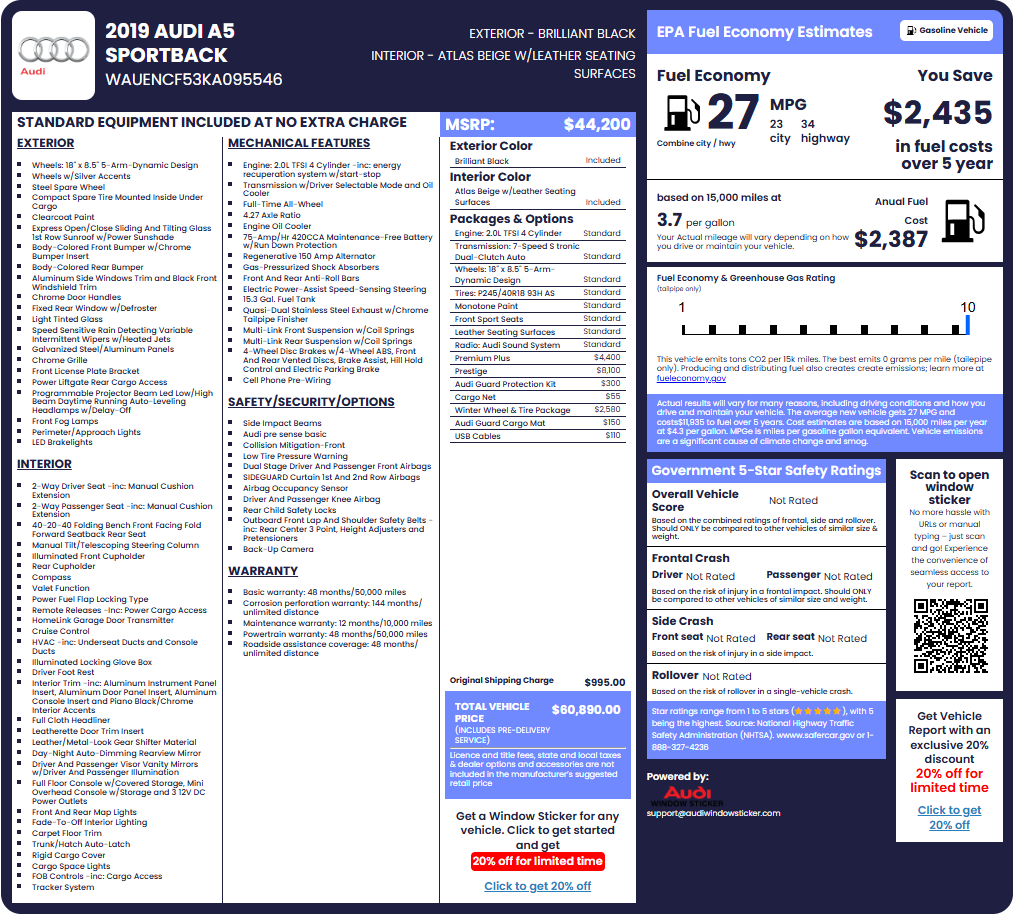
Header
- VIN: WAUENCF53KA095546
- Model: 2019 AUDI A5
- Trim: SPORTBACK
Standard Features (Partial List)
- Wheels: 18" x 8.5" 5-Arm-Dynamic Design.
- 2-Way Driver Seat -inc: Manual Cushion Extension.
- Engine: 2.0L TFSI 4 Cylinder -inc: energy recuperation system w/start-stop.
- Outboard Front Lap And Shoulder Safety Belts -inc: Rear Center 3 Point, Height Adjusters and Pretensioners.
Optional Equipment
| Option | Cost |
|---|---|
| Premium Plus | $4,400 |
| Prestige | $8,100 |
| Audi Guard Protection Kit | $300 |
| Winter Wheel & Tire Package | $2,580 |
← Scroll horizontally to see more →
Fuel Economy
- City: 23 MPG
- Highway: 34 MPG
- Combined: 27 MPG
- Annual Fuel Cost: $2,387
Safety Ratings
- NHTSA Overall Rating: 5 stars
- Frontal Crash: 5 stars (driver), 5 stars (passenger)
MSRP Calculation
| Component | Amount |
|---|---|
| Base Price (Premium Plus) | $44,200 |
| Optional Equipment Total | $15,695 |
| Destination Charge | $995.00 |
| Total MSRP | $61,695 |
← Scroll horizontally to see more →
Vehicle Specifications
- Engine: 2.0L TFSI 4 Cylinder.
- Transmission: 7-Speed S tronic Dual-Clutch Auto
- 4-Wheel Disc Brakes w/4-Wheel ABS, Front And Rear Vented Discs, Brake Assist, Hill Hold Control and Electric Parking Brake.
Warranty
- New Vehicle: 4 years / 50,000 miles
- Powertrain: 4 years / 50,000 miles
- Corrosion: 12 years / unlimited miles
FAQs About How to Read a Window Sticker
What is the most important part of a window sticker?
The optional equipment section is often the most important for verifying factory options and determining a vehicle’s true value. This section lists every package and individual option installed at the factory, along with their original costs.
How can I tell if a window sticker is for the right vehicle?
Check the VIN at the top of the sticker. It should match the VIN on the vehicle’s dashboard (visible through the windshield) and the driver’s side door jamb. If the VINs don’t match, the sticker is for a different vehicle.
What does “destination charge” mean?
The destination charge (also called the delivery fee) is the cost of shipping the vehicle from the factory to the dealership. It is mandatory and included in the MSRP. For Audi, destination charges typically range from $1,095 to $1,295, depending on the model.
Why does the window sticker show fuel economy that’s different from what I get?
EPA estimates are standardized for comparison purposes. Actual fuel economy varies based on driving habits, traffic conditions, vehicle maintenance, and other factors. The estimates help you compare vehicles, but your real-world mileage may differ.
Do all Audis have the same standard features?
No. Standard features vary by trim level (Premium, Premium Plus, Prestige). Higher trims include more standard features. The window sticker’s standard features section shows what comes with that specific trim.
What if my Audi’s window sticker is missing?
You can obtain a recreated digital window sticker using your VIN at AudiWindowSticker.com. This replica contains the same factory information as the original, including all packages, options, and MSRP.
How do I know if an option was factory-installed or dealer-installed?
Factory-installed options appear in the optional equipment section of the window sticker with their cost. Dealer-installed accessories are not listed on the factory window sticker. If a feature isn’t on the sticker, it wasn’t factory-installed.
What does “port-installed accessory” mean?
Port-installed accessories are added at the port of entry before the vehicle reaches the dealership. They appear on the window sticker under optional equipment because they are installed before final delivery. Examples include all-weather floor mats and carbon fiber mirror caps.
Can I get a window sticker for a European-spec Audi?
US-based services typically support US and Canadian market vehicles with standardized 17-character VINs. European-spec vehicles may not be available through these services.
What should I do if the window sticker shows options that aren’t on the vehicle?
This is a serious red flag. It could indicate:
- The sticker is for a different vehicle (VIN mismatch).
- The options were removed after purchase.
- The vehicle was misrepresented.
Verify the VIN matches on the dashboard, door jamb, and sticker. If discrepancies persist, consider having the vehicle inspected by a professional or walking away from the purchase.