
If you have ever shopped for a new or used Audi, you have likely encountered the term MSRP. It appears on window stickers, dealership websites, and financing documents—but what does it actually mean, and why does it matter?
Whether you are buying a new Audi, negotiating a used car purchase, or simply trying to understand your vehicle’s history, understanding MSRP is essential.
Below, we break down everything you need to know about Manufacturer’s Suggested Retail Price (MSRP)—what it includes, how it differs from other pricing terms, and why it remains a critical reference point for Audi owners.
What Does MSRP Stand For?
MSRP stands for Manufacturer’s Suggested Retail Price. It is the price that the automaker—in this case, Audi—recommends that dealerships charge for a specific vehicle.
Characteristics
The MSRP is a recommendation, not a legal requirement. Dealerships are free to sell vehicles above or below the MSRP depending on market demand, inventory levels, and local competition.
Suggested, Not Mandatory
During periods of high demand—such as the launch of a new model or limited-production vehicles like the RS6 Avant or e-tron GT—dealers may charge over MSRP.
Conversely, at the end of the model year or during manufacturer incentive periods, vehicles often sell below MSRP.
Standardized Format
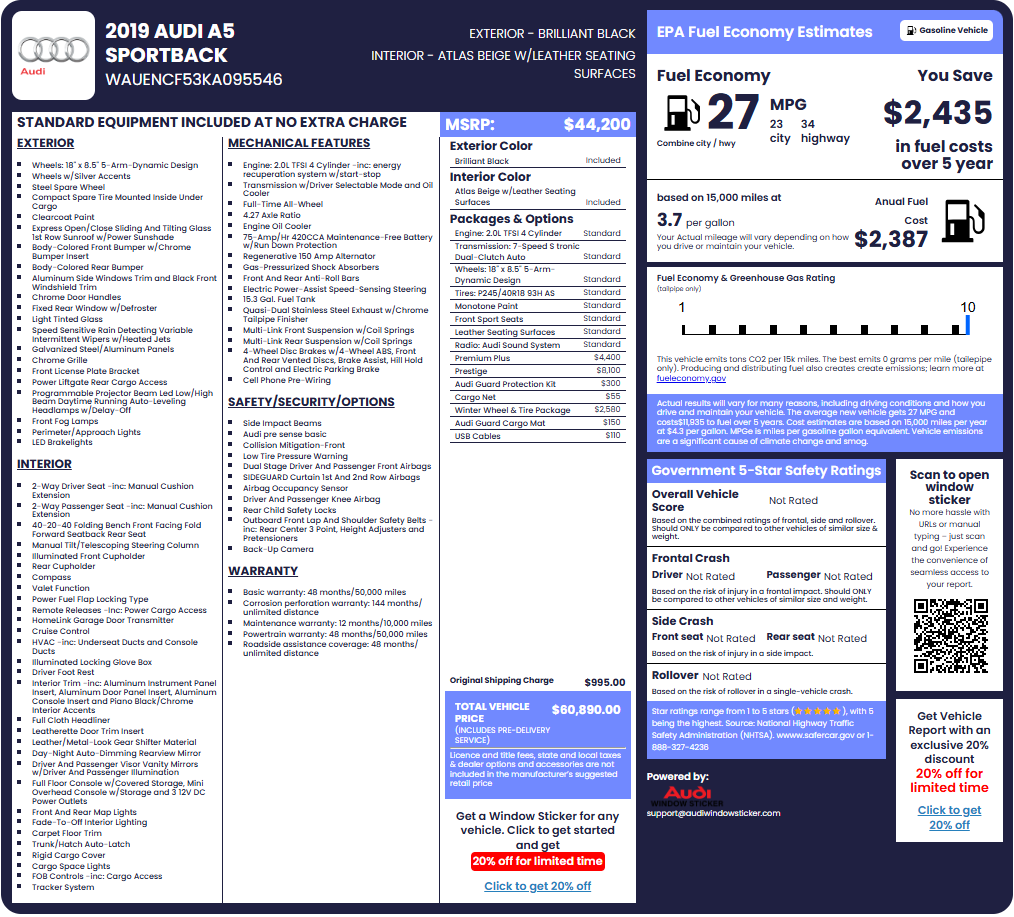
By federal law under the Automobile Information Disclosure Act of 1958, the MSRP must appear on the window sticker (Monroney label) of every new vehicle sold in the United States. This ensures transparency and allows consumers to compare prices across different dealerships and manufacturers. The standardized format includes:
- Base price
- Itemized optional equipment with individual costs
- Destination charge
- Total MSRP
Base Price Plus Options
The MSRP displayed on the window sticker consists of three primary components:
- Base Price: The cost of the vehicle with standard equipment for the chosen trim level.
- Optional Equipment: The cost of factory-installed packages and individual options.
- Destination Charge: The fee for shipping the vehicle from the factory to the dealership.
Why Does an MSRP Matter?
The MSRP serves multiple critical functions:
- Negotiation Starting Point: Establishes a baseline for price discussions.
- Depreciation Reference: Helps calculate how much value a vehicle loses over time.
- Insurance Valuation: Used by insurers to determine actual cash value.
- Financing Benchmark: Lenders use MSRP to calculate loan-to-value ratios.
- Resale Documentation: Demonstrates original value to potential buyers.
What’s Included in MSRP?
Understanding exactly what makes up the MSRP helps you evaluate whether a price is fair and what you are actually paying for.
Base Price
The base price is the cost of the vehicle with its standard trim level and standard equipment before any optional packages or individual options are added.
Audi Trim Levels
For Audi, base trim levels typically include:
- Premium: Entry-level trim with essential luxury features.
- Premium Plus: Mid-level trim adding convenience and technology features.
- Prestige: Top-tier trim with advanced luxury, technology, and driver assistance features
Base Price Examples
| Model | Trim Level | Typical Base Price (2024) |
|---|---|---|
| Audi A3 | Premium | $35,000–$36,000 |
| Audi Q5 | Premium | $45,000–$46,000 |
| Audi Q5 | Prestige | $55,000–$56,000 |
| Audi e-tron GT | Premium Plus | $105,000–$107,000 |
← Scroll horizontally to see more →
Optional Equipment
Factory-installed packages group multiple features together, often at a better value than selecting each option separately. Checking these packages on the window sticker helps confirm exactly what equipment was included when the Audi left the factory.
Factory-Installed Packages
Packages bundle multiple features at a discounted price compared to selecting them individually. Common Audi packages include:
| Package | Typical Cost | Included Features |
|---|---|---|
| Prestige Package | $5,000–$8,000 | Matrix-design headlights, head-up display, upgraded leather, ambient lighting, and advanced audio. |
| S line Sport Package | $1,500–$2,500 | Sport bumpers, sport seats, unique wheels, S line badging. |
| Driver Assistance Package | $1,500–$2,500 | Adaptive cruise control, lane keep assist, intersection assist, parking assist plus. |
| Warm Weather Package | $1,000–$1,500 | Ventilated front seats, rear manual sunshades. |
| Black Optic Package | $1,000–$2,000 | Gloss black exterior trim, unique black wheels. |
← Scroll horizontally to see more →
Individual Options
Standalone features that can be added without a full package:
| Individual Option | Typical Cost |
|---|---|
| Bang & Olufsen Sound System | $1,000–$5,000 (varies by model) |
| Adaptive Air Suspension | $2,000–$4,000 |
| Sport Differential | $1,500–$2,500 (S/RS models) |
| 21” Audi Sport Wheels | $1,000–$2,000 |
| Heated Steering Wheel | $200–$400 |
| Panoramic Sunroof | $1,000–$1,500 |
← Scroll horizontally to see more →
Port-Installed Accessories
Items added at the port of entry before the vehicle reaches the dealership:
- All-weather floor mats: $200–$300
- Carbon fiber mirror caps: $500–$1,000
- Roof rack crossbars: $400–$600
- Paint protection film: $500–$1,500
Destination Charge
The destination fee is what you pay to have the car delivered from the factory to the dealership. It’s a standard charge that’s already set, so it’s not something you can negotiate.
What It Covers
The destination charge (also called delivery fee) covers:
- Transportation from the assembly plant to the dealership
- Fuel for transport vehicles
- Logistics and handling fees
- Insurance during transit
Non-Negotiable
This fee is mandatory and included in the MSRP. It cannot be waived or negotiated. For most Audi models, destination charges typically range from $1,095 to $1,295, depending on:
- Model and size of the vehicle
- Assembly plant location (Ingolstadt, Neckarsulm, Mexico)
- Distance to the destination dealership
Destination Charge Examples
| Model | Assembly Plant | Typical Destination Charge |
|---|---|---|
| Audi A3 | Ingolstadt, Germany | $1,095 |
| Audi Q5 | Mexico | $1,195 |
| Audi Q7 | Neckarsulm, Germany | $1,295 |
| Audi e-tron GT | Neckarsulm, Germany | $1,295 |
← Scroll horizontally to see more →
What Is NOT Included in MSRP
The MSRP does not include the following costs, which are added to the final out-the-door price:
Taxes
- Sales Tax: Varies by state, county, and city. Typically 0–10% of the sale price.
- Use Tax: Applicable in some states for vehicles purchased out of state.
Registration and Title Fees
- Registration Fee: Annual or biennial fee to register the vehicle with the state DMV.
- Title Fee: One-time fee to establish ownership.
- License Plate Fee: Cost of plates and tags.
Dealer Fees
- Documentation Fee (Doc Fee): Dealer processing fee, typically $100–$800.
- Advertising Fee: Sometimes added to cover local or regional marketing.
- Dealer Prep Fee: Covers vehicle inspection and detailing before delivery.
Optional Add-Ons
- Extended Warranty: A service contract beyond the factory warranty.
- GAP Insurance: Covers the difference between the loan balance and the vehicle value.
- Paint Protection: Dealership-applied coatings or film.
- Fabric Protection: Interior sealant treatments.
- Window Tint: Aftermarket tint installed at the dealership.
- Nitrogen Tire Fill: Often overpriced add-on.
Financing Charges
- Interest: Cost of borrowing money.
- Loan Origination Fees: Fees charged by lenders to process the loan.
MSRP vs Other Pricing Terms
Understanding how MSRP compares to other pricing terms helps you see what a vehicle actually costs versus what dealers pay or list. This makes it easier to spot inflated prices and negotiate more effectively when you want to purchase a used Audi.
MSRP vs Invoice Price
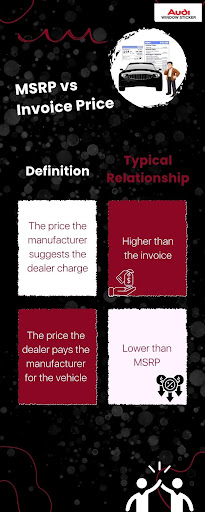
A lot of people are wondering what the difference is between an MSRP and an invoice price. While those might be the same thing, they are not the same.
The invoice price is the price paid by the dealer to the manufacturer, while MSRP stands for the Manufacturer Suggested Retail Price for buyers. The gap between these two prices shows potential dealer profit and gives you a better idea of how to negotiate better with the seller.
Dealer Profit Margin
The difference between MSRP and invoice is the dealer’s potential profit margin. For most Audi vehicles, this gap is typically:
- 5–8% of MSRP for standard models
- 3–5% of MSRP for high-demand or limited models
- 8–10% of MSRP for slow-moving or end-of-year models
Holdback
Manufacturers also provide dealer holdback—a percentage of MSRP (typically 2–3%) returned to the dealer after the vehicle is sold. This gives dealers additional profit even when selling at invoice price.
MSRP vs Market Selling Price
MSRP is the Manufacturer's Suggested Retail Price, while the market selling price reflects the demand, condition, and location of the vehicle. Dealers usually use the MSRP as the baseline of the selling price, as it might be higher or lower
In contrast, the market selling price reflects what the vehicle actually sells for, based on demand, condition, location, and current market trends.
Above MSRP Scenarios
Vehicles may sell above MSRP when:
- Limited production: RS6 Avant, R8, e-tron GT.
- New model launch: First year of a redesigned model.
- Low inventory: Regional shortages or supply chain constraints.
- High demand: Popular configurations or rare options.
Below MSRP Scenarios
Vehicles may sell below MSRP when:
- End of model year: New models arriving soon.
- Excess inventory: Dealership has more units than demand.
- Manufacturer incentives: Rebates, special financing, or lease deals.
- Slow-selling models: Less popular trims or configurations.
MSRP vs Dealer Advertised Price
MSRP is the price suggested by the manufacturer to give buyers a reference point, while the dealer price is what the dealership actually charges, which can be higher or lower depending on demand, markups, or discounts.
Common Advertising Practices
Dealerships often advertise prices below MSRP to attract buyers. However, advertised prices may contain conditions:
| Advertising Practice | What to Watch For |
|---|---|
| Excludes Destination | Price shown without destination charge; added back later. |
| Includes All Rebates | Assumes buyer qualifies for every available incentive. |
| Requires Financing | Advertised price only valid with dealer financing. |
| Military/First Responder | Additional discounts for specific groups only. |
| Loyalty Bonus | Requires current Audi ownership. |
← Scroll horizontally to see more →
MSRP vs Out-the-Door Price
The out-the-door price is the final total you pay to drive the vehicle off the lot.
Components
| Component | Included in MSRP? | Included in OTD? |
|---|---|---|
| Base Price | Yes | Yes |
| Optional Equipment | Yes | Yes |
| Destination Charge | Yes | Yes |
| Sales Tax | No | Yes |
| Registration Fees | No | Yes |
| Documentation Fee | No | Yes |
| Dealer Add-Ons | No | Varies |
| Extended Warranty | No | Varies |
← Scroll horizontally to see more →
Negotiation Tip
Always negotiate based on the out-the-door price, not just the MSRP or advertised price. This prevents dealers from adding unexpected fees later in the process.
Why MSRP Matters for Audi Owners
MSRP is more than just a price tag put on a car, as it also serves as the reference point for evaluating value, comparing trims, and understanding how features impact costs. The MSRP also serves as a negotiation point with the seller.
New Car Buying
When buying a new Audi, MSRP helps you understand the vehicle’s starting price before discounts or incentives. It provides a clear benchmark, allowing you to assess dealer offers and identify whether a deal is competitive.
Establishing a Baseline
When purchasing a new Audi, MSRP acts as the starting point for negotiation. Comparing it with the invoice price helps buyers estimate dealer margins and determine a reasonable offer based on the vehicle’s true market position.
Research Before Visiting the Dealer
Use resources like the Audi MSRP by VIN to view the exact MSRP breakdown for any vehicle using its VIN. This allows you to:
- Compare pricing across multiple dealerships.
- Understand the cost of each option and package.
- Identify which features are standard vs optional.
Timing Your Purchase
MSRP matters for timing your purchase:
- End of the month/quarter: Dealers may offer better discounts to meet sales targets.
- End of model year: Larger discounts as new models arrive.
- Holiday sales events: Memorial Day, Labor Day, and year-end events often feature manufacturer incentives.
Used Car Valuation
For used Audi vehicles, the original MSRP provides essential context for understanding depreciation and current value. It helps buyers and sellers assess how pricing has changed over time and determine whether the asking price aligns with the vehicle’s condition, mileage, and features.
Depreciation Context
A used Audi that originally cost $70,000 with the Prestige Package and advanced options should command a higher price than a base model that stickered for $50,000, even if both are the same age and mileage.
Option Value Retention
Not all options depreciate equally. Options that tend to retain value include:
- Sport differential (S/RS models)
- Adaptive air suspension
- Bang & Olufsen sound system
- Prestige Package (versus Premium Plus)
- Rare paint colors (e.g., Nogaro Blue, Suzuka Gray)
Insurance and Claims
MSRP plays an important role in insurance assessments. It helps establish a vehicle’s original value, giving insurers a reference point when calculating depreciation and determining fair compensation in the event of damage or total loss.
Total Loss Valuation
Insurance companies use the original MSRP—along with depreciation—to determine:
- Actual Cash Value (ACV): The pre-loss value of the vehicle.
- Settlement amount: What you receive if the vehicle is declared a total loss.
Agreed Value Policies
For collector or high-value Audis, agreed value policies use the original MSRP and documented options to establish a guaranteed payout amount in the event of a total loss.
Premium Calculations
MSRP affects premium calculations for:
- Comprehensive coverage: Theft, fire, vandalism.
- Collision coverage: Damage from accidents.
- GAP insurance: Difference between the loan balance and the ACV.
Financing and Loans
The MSRP is sometimes used by lenders to calculate the loan value.
Loan-to-Value Ratios
Lenders use the MSRP and invoice price to calculate loan-to-value (LTV) ratios:
- LTV = Loan Amount ÷ Vehicle Value
- A vehicle financed at or below MSRP with a reasonable down payment is more likely to qualify for favorable interest rates.
- High LTV ratios (above 100%) may require higher rates or additional down payment.
Lease Calculations
MSRP is a primary factor in lease calculations:
- Capitalized Cost: Negotiated price (ideally below MSRP).
- Residual Value: Percentage of MSRP projected at lease end.
- Monthly Payment: Lower when the capitalized cost is below the MSRP.
Resale and Trade-In
When selling your Audi privately or trading it in, providing the original MSRP—via the window sticker—demonstrates the vehicle’s original value and helps justify your asking price. Buyers appreciate transparency about the original configuration and cost.
Private Party Sales
In private party sales, having the original MSRP breakdown helps:
- Justify the asking price compared to similar vehicles.
- Show that premium options were factory-installed, not aftermarket.
- Build trust with potential buyers.
Trade-In Negotiation
When trading in at a dealership, the original MSRP provides leverage:
- Demonstrates that your vehicle has desirable factory options.
- Supports your position that the vehicle was higher-spec than base models.
- Helps counter low initial trade-in offers.
How to Find the MSRP for Your Audi
Finding the MSRP on an Audi is easy; you just need to get the window sticker to see its complete MSRP and its pricing breakdown section.
Original Window Sticker
The original window sticker provides the most accurate MSRP, including a full breakdown of base price, factory options, packages, and destination charges. It reflects the exact configuration of the vehicle when it left the factory.
Location
The most authoritative source for MSRP is the original window sticker (Monroney label). If you are the first owner, check:
- Glove box
- Side window
- Driver’s side rear window
- On the front windshield
What It Shows
The original window sticker displays:
- Base price for the specific trim level
- Itemized optional equipment with individual costs
- Destination charge
- Total MSRP
- EPA fuel economy ratings
- Standard equipment list
Recreated Window Sticker
If the original is lost, you can obtain a digital replica through services like the Audi window sticker by VIN. Simply enter your VIN to retrieve:
- Complete MSRP breakdown with base price
- Itemized optional equipment costs
- Destination charge
- Total MSRP
- All factory-installed packages and options
Advantages
- Instant delivery: No waiting or dealership visit required
- Accurate data: Pulls directly from Audi factory build records
- Affordable: Typically lower cost than dealer fees
- Digital format: Can be stored, printed, or shared electronically
VIN Decoding Services
You can use any kind of online VIN decoding service to get a copy of the window sticker. However, not all VIN decoder tools can be used to retrieve the window sticker.
Limitations
Basic VIN decoders can provide limited information, including:
- Model year
- Trim level (Premium, Premium Plus, Prestige)
- Engine type
- Transmission
- Assembly plant
What They Don’t Show
Basic VIN decoders typically do not include:
- Itemized pricing for options
- Destination charge
- Total MSRP
- Package details
For accurate MSRP with itemized options, a dedicated window sticker service is required.
Common Misconceptions About MSRP
Many buyers misunderstand what MSRP actually means, which can lead to confusion when comparing prices or negotiating with dealers. Here are some of the most common misconceptions to watch out for.
MSRP is the final price you pay
Fact: MSRP is a suggestion, not a requirement. Dealers can sell above or below MSRP. Always negotiate based on market conditions and the out-the-door price. Many buyers successfully negotiate 3–8% below MSRP on standard Audi models.
The destination charge is optional
Fact: The destination charge is mandatory and included in the MSRP. It covers the cost of shipping the vehicle from the factory to the dealership and cannot be waived or negotiated. Attempting to remove this fee is not possible; instead, negotiate the overall sale price.
MSRP includes taxes and fees
Fact: MSRP does not include sales tax, registration, documentation fees, or dealer-installed accessories. These are added to the final out-the-door price, which can be 5–15% higher than MSRP depending on location and add-ons.
Used cars don’t have an MSRP
Fact: Every new vehicle has an MSRP. For used cars, the original MSRP remains relevant for depreciation calculations, insurance valuations, and understanding the vehicle’s original market position. A used car with a higher original MSRP typically retains more value than a base model.
MSRP is the same as invoice price
Fact: MSRP is what the manufacturer suggests the dealer charge. The invoice price is what the dealer paid the manufacturer. The difference is the dealer’s potential profit margin, typically 5–8% for most Audi models. Dealers also receive holdback (2–3% of MSRP) as additional profit.
All dealerships have the same MSRP
Fact: MSRP is set by the manufacturer and is identical across all dealerships for the same vehicle with the same options. However, dealerships may offer different selling prices based on local competition, inventory levels, and regional incentives.
MSRP is only for new cars.
Fact: While MSRP is established when a vehicle is new, it remains a valuable reference point throughout the vehicle’s life. Insurance companies, lenders, and used car buyers all reference original MSRP to assess value.
How MSRP Affects Vehicle Depreciation
The MSRP serves as the baseline of vehicle depreciation. New cars usually lose value early on, and higher-priced models often see bigger losses in actual dollars, especially compared to more practical or in-demand vehicles.
What is Vehicle Depreciation
Depreciation is the difference between the original MSRP and the current market value. Luxury vehicles like Audi typically experience significant depreciation in the first few years.
Average Depreciation Rates
Want to know about the vehicle depreciation rates? Check this section to see how a vehicle depreciates over time.
| Time Period | Typical Depreciation (from MSRP) |
|---|---|
| First Year | 15–25% |
| Second Year | 25–35% |
| Third Year | 40–50% |
| Fifth Year | 55–65% |
| Seventh Year+ | 65–75% |
← Scroll horizontally to see more →
Factors Affecting Depreciation
MSRP is just a starting point. A vehicle’s depreciation is also influenced by other factors that can affect how quickly its value drops over time.
Trim Level
Higher trims often depreciate differently:
- Prestige models: Depreciate slightly slower than Premium or Premium Plus.
- Limited models (RS, R8): Depreciate much more slowly, sometimes appreciating.
- Base models: Depreciate faster due to lower original MSRP and fewer desirable features.
Options That Retain Value
| Option | Impact on Depreciation |
|---|---|
| Sport Differential | Positive; highly desirable in S/RS models |
| Adaptive Air Suspension | Positive; sought-after for comfort |
| Bang & Olufsen Sound | Positive; premium feature |
| Prestige Package | Positive; bundles desirable features |
| Rare Paint Colors | Positive; collector appeal |
| S line Sport Package | Moderate; enhances appearance |
| Dealer Accessories | Negative; rarely add resale value |
← Scroll horizontally to see more →
Mileage and Condition
- Low mileage: Significantly reduces depreciation
- Full service history: Improves value retention
- Accidents: Accelerates depreciation
- Number of owners: Fewer owners typically means better value
Calculating Current Value
Using original MSRP to estimate current value:
- Start with original MSRP (including all options)
- Apply the depreciation percentage based on age and mileage
- Adjust for condition: Add or subtract based on vehicle condition
- Factor in market conditions: Regional demand, seasonality
FAQs About What is an MSRP
What does MSRP stand for?
MSRP stands for Manufacturer’s Suggested Retail Price. It is the price that the automaker recommends dealerships charge for a new vehicle. In the automotive industry, it is also commonly referred to as the sticker price because it appears on the window sticker (Monroney label).
Is MSRP the same as the invoice price?
No. MSRP is the suggested retail price for consumers. Invoice price is what the dealer pays the manufacturer. The difference between the two represents the dealer’s potential profit margin, typically 5–8% for most Audi models. Dealers also receive holdback (2–3% of MSRP) as additional profit.
Does MSRP include taxes and fees?
No. MSRP includes the base price, optional equipment, and destination charge. It does not include sales tax, registration fees, dealer documentation fees, or any dealer-installed accessories. These are added to the final out-the-door price.
Can I negotiate below MSRP?
Yes. MSRP is a suggestion, not a legal requirement. Depending on market conditions, inventory levels, and the time of year, many Audi dealerships are willing to negotiate 3–8% below MSRP on standard models. Limited-production or high-demand models (like the RS6 Avant or R8) may sell at or above MSRP.
Where can I find the MSRP for my Audi?
The MSRP appears on the original window sticker (Monroney label). If the original is lost, you can obtain a recreated window sticker using your VIN, which provides the exact MSRP breakdown, including base price, options, and destination charge.
Why is MSRP important for used car buyers?
For used car buyers, the original MSRP provides critical context for:
- Understanding the vehicle’s original market position.
- Verifying that the current asking price is fair relative to the original value.
- Confirming that the vehicle has desirable factory options that justify a higher price.
- Calculating depreciation to assess long-term value.
What is the difference between MSRP and market selling price?
MSRP is the manufacturer’s suggested price. Market selling price is what dealerships actually charge based on supply and demand. In a competitive market, vehicles may sell below MSRP. In high-demand situations, vehicles may sell above MSRP.
Does MSRP matter for electric Audis (e-tron models)?
Yes. For Audi electric vehicles like the Q4 e-tron, Q8 e-tron, and e-tron GT, the MSRP is equally important. It includes the base price, optional equipment (such as the Technology Package or adaptive air suspension), and the destination charge. MSRP also affects federal and state EV tax credit eligibility, as some credits have MSRP caps.
Can I use MSRP to calculate my Audi’s current value?
Yes. The original MSRP serves as the starting point for depreciation calculations. By applying average depreciation rates for the vehicle’s age, mileage, and condition, you can estimate the current market value. However, actual value also depends on local market conditions, service history, and specific options.
What is the destination charge in MSRP?
The destination charge (also called the delivery fee) is the cost of shipping the vehicle from the assembly plant to the dealership. It is mandatory and included in the MSRP. For Audi vehicles, destination charges typically range from $1,095 to $1,295, depending on the model and shipping distance.
How do manufacturer incentives affect MSRP?
Manufacturer incentives—such as cash rebates, special financing, or lease deals—do not change the MSRP. Instead, they reduce the effective purchase price after the fact. Rebates are applied after negotiating the sale price, so always negotiate the price first, then apply available incentives.
What is the difference between MSRP and base price?
The base price is the cost of the vehicle with standard equipment for the chosen trim level. The MSRP is the base price plus optional equipment and the destination charge. A fully loaded Audi may have an MSRP that is $15,000–$25,000 higher than the base price.
Does MSRP include the cost of shipping?
Yes. The destination charge—which covers shipping from the factory to the dealership—is included in the MSRP. This fee is non-negotiable and appears as a separate line item on the window sticker.
Can I get a window sticker with MSRP for a vehicle I already own?
Yes. If you own an Audi and the original window sticker is lost, you can obtain a recreated window sticker using your VIN at the Audi window sticker by VIN. No need to worry about the quality, as it also highlights the same information written on the initial window sticker from the Audi manufacturer.