How Dealers Use Window Stickers When Pricing Used Cars
 GraciaPublished inWindow Sticker

If you ever shop for a used car, you may have noticed that similar vehicles are priced differently. Two same-year, same-model Audi cars with close mileage can still carry very different price tags.
One of the main reasons is the window sticker. Dealers use this information to assess original value, features, and overall desirability. Understanding how it influences pricing helps you negotiate more effectively and make better buying or selling decisions.
Below, we break down exactly how dealers use window stickers when pricing used cars, and what crucial factors make them put prices differently.
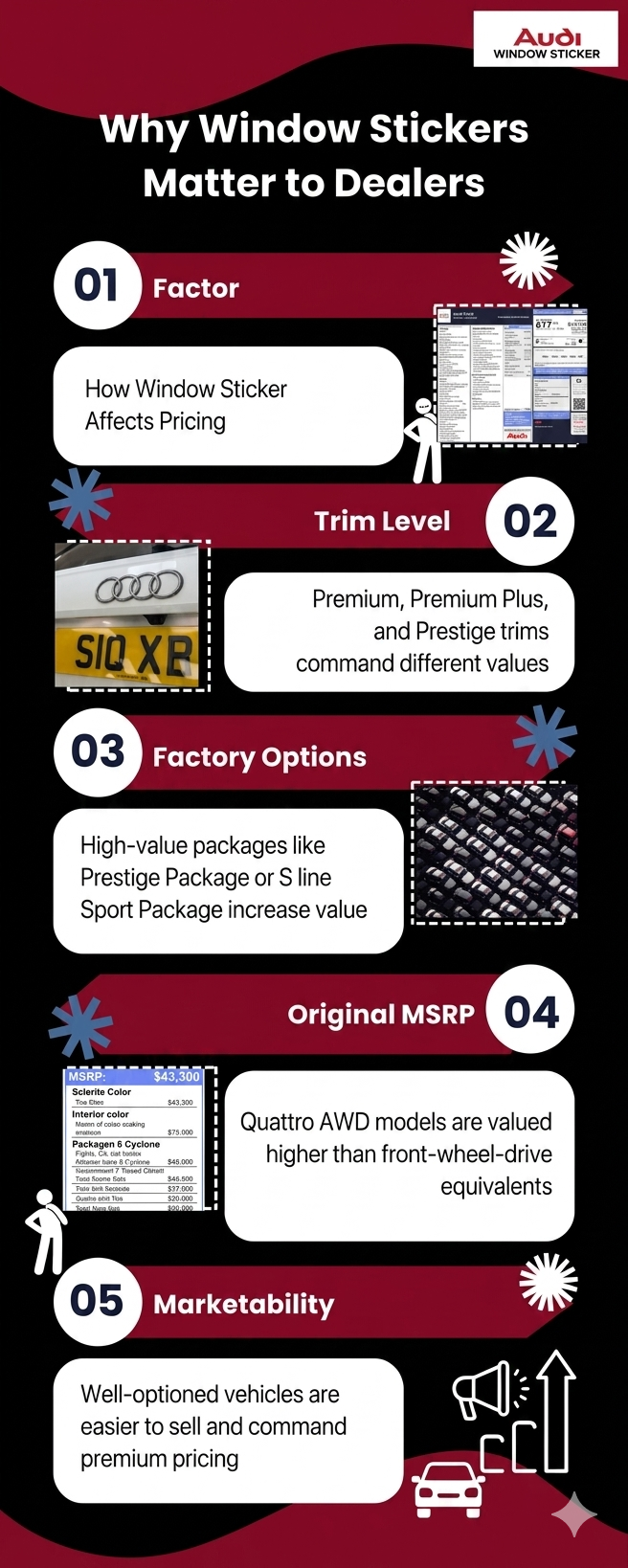
Why Window Stickers Matter to Dealers
For a dealership, a used car is an inventory asset that needs to be priced correctly to:
- Sell quickly enough to avoid holding costs
- Maximize profit margin
- Compete with other dealerships
- Meet lender requirements for financing
The window sticker provides dealers with authoritative documentation of the vehicle’s original factory configuration.
Step-by-Step: How Dealers Price Used Cars Using Window Stickers
Dealers rely on the build data to establish an accurate starting point for pricing. Reviewing the original specifications, features, warranty attached, and MSRP helps dealers assess the surface level of a vehicle before moving to its condition.
Step 1: Obtain the Vehicle’s Factory Specifications
When a dealer acquires a used vehicle—whether through trade-in, auction, or purchase—the first step is to pull the factory build data using the VIN.
Methods Dealers Use
| Method | Description |
|---|---|
| Method | Description |
| Dealer Management System (DMS) | Internal software that accesses manufacturer databases |
| VIN Decoding Tools | Specialized software that pulls detailed option data |
| Window Sticker Lookup | Some dealers use services like the Audi window sticker to generate replicas |
| Original Window Sticker | If the original sticker is still with the vehicle, it provides instant documentation |
← Scroll horizontally to see more →
What Dealers Look For
- Trim level: Premium, Premium Plus, or Prestige.
- Packages: Prestige Package, S line Sport Package, Driver Assistance Package.
- Individual options: Bang & Olufsen sound, adaptive air suspension, sport differential.
- Drivetrain: Quattro AWD or front-wheel drive.
- Original MSRP: Total vehicle cost when new.
Step 2: Compare to Market Data
Once the factory specifications are documented, dealers compare the vehicle to market data to determine a competitive price.
Data Sources
| Source | Information Provided |
|---|---|
| Auction Data (Manheim, ADESA) | Recent wholesale prices for similar vehicles |
| Market Reports (Black Book, Kelley Blue Book) | Regional retail and trade-in values |
| Competitor Listings | What other dealers are asking for similar vehicles |
| Historical Sales Data | Dealership’s own sales history for similar models |
← Scroll horizontally to see more →
How Factory Options Affect Market Comparisons
A dealer cannot simply compare a base model to a loaded model. The window sticker allows them to:
- Match trim level for trim level (Premium vs Premium Plus vs Prestige).
- Account for specific packages that add value.
- Identify rare options that command premium pricing.
Step 3: Calculate Wholesale (Trade-In) Value
When a dealer appraises a trade-in, they start with the wholesale value—what they expect to receive at auction or what they can profitably retail the vehicle for after reconditioning.
Trade-In Valuation Factors
| Factor | Impact on Value |
|---|---|
| Trim Level | Prestige adds $2,000–$4,000 over Premium |
| Premium Packages | Prestige Package adds $1,500–$3,000 to wholesale value |
| S line Sport Package | Adds $1,000–$2,000 |
| Bang & Olufsen Sound | Adds $500–$1,500 |
| Adaptive Air Suspension | Adds $1,000–$2,000 |
| Quattro AWD | Adds $1,500–$2,500 over FWD |
| Mileage | Deducts $0.10–$0.25 per mile over average |
| Condition | Adjusts based on wear, damage, and service history |
← Scroll horizontally to see more →
How Window Stickers Protect Dealers
By verifying factory options via the window sticker or build data, dealers ensure they:
- Don’t overpay for a base model disguised as a higher trim.
- Properly value rare options that increase wholesale demand.
- Avoid paying for aftermarket modifications that don’t add wholesale value.
Step 4: Determine Retail Price
After calculating wholesale value and adding reconditioning costs, dealers set the retail price. The window sticker plays a critical role in justifying the retail price to potential buyers.
Retail Pricing Components
| Component | Description |
|---|---|
| Wholesale Cost | What the dealer paid (trade-in or auction purchase) |
| Reconditioning | Cost of detailing, mechanical repairs, tires, etc. |
| Profit Margin | Typically 10–20% of wholesale cost |
| Market Adjustment | + or – based on local supply and demand |
← Scroll horizontally to see more →
How Factory Options Justify Retail Price
When a dealer prices a used Audi higher than a competitor’s listing, the window sticker provides the documentation to justify the premium:
| Premium Feature | Justification for Higher Price |
|---|---|
| Prestige Package | Adds head-up display, matrix headlights, upgraded leather, advanced audio |
| S line Sport Package | Adds sport bumpers, sport seats, unique wheels |
| Bang & Olufsen Sound | Premium audio system valued by enthusiasts |
| Adaptive Air Suspension | Enhanced ride comfort and adjustable height |
| Sport Differential | Performance feature sought by S/RS buyers |
| Quattro AWD | Superior traction and resale value |
← Scroll horizontally to see more →
Step 5: Create Marketing Materials
The window sticker information is used to create the vehicle listing that appears on the listing description of the vehicle you can find on the dealer’s website or marketplace like facebook.
What Dealers Highlight from Window Stickers
How Dealers Use Window Stickers for Different Acquisition Channels
Dealers adjust how they use window stickers based on how a vehicle is sourced, whether through trade-ins, auctions, or direct purchases. The factory data helps verify specifications, confirm original MSRP, and assess equipment levels to set accurate pricing.
Trade-In Vehicles
When a customer trades in a vehicle, the dealer uses the VIN to pull factory specifications and compare to market data.
What Dealers Look For
- Original MSRP: Higher original price typically means higher trade value.
- Factory options: Well-optioned vehicles command better trade-in offers.
- Trim level: Prestige models are valued significantly higher than Premium models.
How This Affects You
If you are trading in your Audi, having the window sticker or being able to articulate your vehicle’s factory options helps you:
- Justify your desired trade value.
- Counter a low initial offer by documenting premium options.
- Negotiate based on factory specifications rather than generic book values.
Auction Vehicles
Dealers purchase many used vehicles at wholesale auctions. Before bidding, they review auction listings that often include window sticker data or factory build sheets.
How Window Stickers Influence Bidding
- Higher bids for vehicles with premium packages and desirable options.
- Lower bids for base models with few options.
- Aggressive bidding for rare configurations or limited-production models.
Lease Returns
When a leased Audi is returned, the dealership or leasing company evaluates the vehicle using factory specifications to determine:
- Excess wear and tear charges (compared to original equipment).
- Lease-end value (based on original MSRP and residual percentage).
- Certified Pre-Owned (CPO) eligibility.
How Window Stickers Affect Certified Pre-Owned (CPO) Pricing
Audi’s Certified Pre-Owned (CPO) program requires vehicles to meet strict criteria, including:
- Being within a certain age and mileage range.
- Passing a thorough inspection.
- Having a clean title and service history.
CPO Pricing Premium
CPO vehicles often come with higher prices because they include verified specifications, extended warranties, and strict inspection. In this case, the window sticker is used as a supporting document that validates the claim.
| Factor | Impact on CPO Price |
|---|---|
| CPO Warranty | Adds $1,500–$3,000 to retail price |
| Factory Options | Well-optioned CPO vehicles command highest premiums |
| Original MSRP | Higher original value supports higher CPO price |
← Scroll horizontally to see more →
Why Window Stickers Matter for CPO
Dealers use window sticker data to:
- Verify the vehicle meets CPO eligibility for original equipment.
- Market CPO vehicles with detailed option lists.
- Justify CPO pricing by showing original value and factory configuration.
How Dealers Use Window Stickers to Negotiate with Buyers
Dealers often use the window sticker to negotiate with buyers and use it as a reference point during the negotiation process. The window sticker is often used as a reference point during negotiation, highlighting the original MSRP, factory options, and trims.
Justifying Selling Prices
When a buyer questions why a particular used Audi is priced higher than a competitor’s listing, the dealer can use the window sticker to demonstrate:
| Buyer Objection | Dealer Response Using Window Sticker |
|---|---|
| “Why is this one $3,000 more?” | “This has the Prestige Package, S line package, and Bang & Olufsen—those added $10,000 when new.” |
| “I found a cheaper one online.” | “That one is a Premium model without any packages. This is a Prestige with every option.” |
| “Can you match the lower price?” | “The factory options on this vehicle make it worth more. Here’s the original MSRP breakdown.” |
← Scroll horizontally to see more →
Addressing Trade-In Lowballs
When a customer feels their trade-in offer is too low, the dealer may:
- Pull the window sticker to show the original configuration.
- Explain that base models have lower wholesale values.
- Show market data comparing similarly equipped vehicles.
Building Trust
Dealers who provide window stickers to buyers build trust and transparency. A vehicle listing that includes the original window sticker or a detailed option list:
- Attracts more serious buyers.
- Reduces time spent answering questions about features.
- Justifies the asking price.
Why a Window Sticker is Crucial for Buyers
Understanding the window sticker before you purchase a used Audi is crucial. It helps you to evaluate the car’s equipment levels and features, ensuring you compare the models accurately and recognize features that justify higher prices.
The Perks of Reviewing a Window Sticker
Review the window sticker before you make a decision to purchase the window sticker. On the window sticker, you can find valuable information like options, understand the vehicle’s true differences, and compare its models to avoid overpaying.
- Obtain the window sticker for any vehicle you are considering using the VIN.
- Understand what options add value (Prestige Package, S line, Bang & Olufsen, adaptive air suspension, sport differential).
- Compare apples to apples—don’t compare a base model to a loaded model without adjusting for price differences.
During Negotiations
Use the window sticker as your reference point during discussions. It helps you challenge pricing, verify claimed features, and justify your offer based on the vehicle’s actual configuration rather than assumptions or dealer positioning.
| Scenario | Strategy |
|---|---|
| Dealer claims vehicle is “fully loaded” | Verify against window stickers. If options are missing, use that as leverage. |
| Dealer asks a premium for options | Confirm the options are actually factory-installed using the window sticker. |
| Dealer won’t negotiate | Use the window sticker to identify if the vehicle lacks desirable options that competitors offer. |
| Trade-in offer seems low | Present your own window sticker to document your vehicle’s premium options and original MSRP. |
← Scroll horizontally to see more →
After Purchase
Keep your window sticker (original or recreated) with your vehicle records. It will be valuable for:
- Future trade-in negotiations.
- Private party resale (buyers appreciate documentation).
- Insurance claims (documenting original value and options).
How to Get a Window Sticker for a Used Audi
If the original window sticker is missing—which is common for used vehicles—you can still obtain a recreated digital window sticker using the VIN.
Recreated Window Sticker Benefits
| Benefit | Value to Buyers |
|---|---|
| Same factory data | 100% accurate to original build |
| Quick Process | Get the window sticker in less than a minute |
| Affordable | Lower cost than dealer fees |
| Portable | Digital format easy to share or print |
← Scroll horizontally to see more →
Dealership Option
You can also ask the dealer to provide a printout of the factory build data. Some dealers may charge $50–$100 for this service.
Get the Audi Window Sticker by Yourself
You can get the replica window sticker by yourself by using our service. Use the Audi window sticker by VIN tool by filling out the form, then submit it. Our sticker only costs $19.99 and you can download the sticker or print it right away.
Frequently Asked Questions
Do dealers always use window stickers when pricing used cars?
Reputable dealers use factory build data (which the window sticker represents) to accurately price used cars. This ensures they account for trim level, packages, and individual options that affect value. Dealers who skip this step risk overpaying for trade-ins or mispricing inventory.
Can a dealer’s asking price be higher because of options on the window sticker?
Yes. Vehicles with premium factory options—such as the Prestige Package, S line Sport Package, or Bang & Olufsen sound system—command higher retail prices. The window sticker documents these options and helps justify the premium.
How do I know if a dealer’s price is fair based on the window sticker?
- Obtain the window sticker using the VIN.
- Identify the trim level and installed packages.
- Compare the asking price to similar vehicles with the same factory options.
- Use resources like Kelley Blue Book or Edmunds, inputting the exact trim and options.
Should I ask the dealer for the window sticker before making an offer?
Absolutely. Asking for the window sticker (or at least the VIN to generate one yourself) demonstrates you are an informed buyer. It also allows you to verify the vehicle’s configuration before negotiating.
How does the original MSRP on the window sticker affect used car pricing?
Higher original MSRP typically translates to higher used value. A vehicle that originally cost $65,000 with premium options should be priced higher than a base model that stickered for $50,000—even if both are the same year and mileage.
Do dealers care about aftermarket modifications?
Generally, no. Aftermarket modifications—wheels, tint, audio upgrades—do not add significant value to a used car in a dealership’s pricing model. In some cases, they may reduce value if they deviate from factory specifications. Dealers rely on factory options from the window sticker, not aftermarket additions.
What if the dealer won’t provide the VIN or window sticker?
Consider this a red flag. A transparent dealer should have no issue providing the VIN so you can verify the vehicle’s history and specifications. If they refuse, consider shopping elsewhere.
Can I use a recreated window sticker for trade-in negotiations?
Yes. A recreated window sticker from a reputable service contains the same factory data as the original. Presenting it during trade-in negotiations helps document your vehicle’s premium options and original MSRP, supporting your desired trade value.
How do dealers handle vehicles without window stickers?
Dealers can access factory build data using the VIN through their dealer management systems. They don’t need the physical window sticker to price the vehicle accurately. However, as a buyer, obtaining your own copy ensures you have the same information the dealer has.
What’s the biggest mistake buyers make regarding window stickers?
Assuming that all vehicles of the same model and year are priced similarly. The window sticker reveals significant differences in trim level, packages, and options that can account for thousands of dollars in price variation. Buyers who skip this step often overpay for base models or miss out on well-optioned vehicles priced competitively.
About Gracia
10 articles published
Gracia Anindita is an SEO content writer with two years of experience across the automotive, tourism, and real estate industries. At Audi Window Sticker, she creates well-researched articles about Audi window stickers, factory options, vehicle specifications, and VIN decoding. Her clear, engaging writing helps Audi buyers and owners understand vehicle details and make informed decisions.