
Buying a used Audi can be exciting, but it also comes with risks if you are not sure what the vehicle actually includes. Two similar-looking cars can have very different values depending on their original factory options.
Getting a window sticker can help you spot these features and packages. By reviewing it before you buy, you can avoid overpaying, spot missing options, and negotiate better to get the best price.
What Are the Things That Might Not Be Revealed by the Seller?
When you look at a used car listing, you typically see:
- Year, make, and model
- Mileage
- A few photos
- A brief description
What you don’t see is the complete story of how the vehicle was originally configured. That’s where the window sticker comes in.
The Information Gap
| What Sellers Typically Show | What the Window Sticker Reveals |
|---|---|
| Trim level (e.g., Premium Plus) | Exactly which packages were added (Prestige Package, S line Sport Package) |
| “Fully loaded” claims | Whether all options are actually factory-installed |
| Basic engine info | Specific drivetrain (Quattro AWD or FWD) |
| Listing price | Original MSRP with itemized option costs |
← Scroll horizontally to see more →
Without the window sticker, you are relying on the seller’s word—or worse, making assumptions that can cost you money.
How Checking a Window Sticker Saves You Money
A window sticker gives you a clear view of a vehicle’s original pricing and features, helping you understand what it was truly worth when new. This makes it easier to spot overpriced listings and avoid paying for options that are not actually included.
By comparing the sticker details with the current condition and market price, you can make more accurate decisions, negotiate with confidence, and identify better value across similar vehicles.
1. Avoid Overpaying for Base Models Disguised as Higher Trims
One of the most common pitfalls in used car buying is paying Premium Plus or Prestige prices for a base Premium model that lacks desirable options.
Real-World Example
| Vehicle | Seller’s Claim | Window Sticker Reality | Price Difference |
|---|---|---|---|
| 2021 Audi Q5 | “Fully loaded Premium Plus” | Actually, a Premium model with no added packages | $3,000–$5,000 overvalued |
← Scroll horizontally to see more →
How the Window Sticker Helps:
- The window sticker clearly shows the official trim level (Premium, Premium Plus, Prestige).
- It lists every factory-installed package, so you can verify whether the “fully loaded” claim is accurate.
- If the vehicle lacks the Prestige Package or other high-value options, you can negotiate accordingly—or walk away.
2. Verify High-Value Factory Options Before Paying a Premium
Some factory options add significant value to a used Audi. A seller may charge extra for these features, but without the window sticker, you cannot be sure they were factory-installed—or even present at all.
High-Value Options to Verify
| Option | Typical New Cost | Used Value Impact |
|---|---|---|
| Prestige Package | $5,000–$8,000 | Adds $2,000–$4,000 to the used value |
| S line Sport Package | $1,500–$2,500 | Adds $1,000–$2,000 to the used value |
| Bang & Olufsen Sound System | $1,000–$5,000 | Adds $500–$2,000 to used value |
| Adaptive Air Suspension | $2,000–$4,000 | Adds $1,000–$2,500 to used value |
| Sport Differential | $1,500–$2,500 | Adds $1,000–$2,000 to used value (S/RS models) |
| Driver Assistance Package | $1,500–$2,500 | Adds $500–$1,500 to used value |
← Scroll horizontally to see more →
How the Window Sticker Helps:
- The window sticker lists every factory option with its original cost.
- You can verify that the vehicle actually has the features the seller is using to justify a higher price.
- If options are missing, you can negotiate down or look for a better-equipped vehicle at the same price point.
3. Identify Misrepresented Features and Aftermarket Add-Ons
Some sellers add aftermarket badges, wheels, or accessories to make a base model appear higher-spec. Without the window sticker, it can be difficult to tell what came from the factory and what was added later.

Why is an Audi Window Sticker crucial?
- The window sticker is the definitive record of factory-installed equipment.
- If a feature is not listed, it was not factory-installed.
- Aftermarket additions generally do not add resale value—and may even reduce it.
- You can avoid paying for features that aren’t genuine factory options.
4. Calculate Fair Market Value Based on Original MSRP
The original MSRP—including base price and optional equipment—provides a baseline for understanding a vehicle’s market position. A car that originally cost $65,000 with the Prestige Package and advanced options should command a higher used price than a base model that stickered for $50,000, even if both are the same age and mileage.
Depreciation Context
| Original MSRP | Typical 3-Year Value | Value Difference |
|---|---|---|
| $50,000 (base) | $25,000–$30,000 | Baseline |
| $65,000 (loaded) | $32,500–$39,000 | $7,500–$9,000 higher |
← Scroll horizontally to see more →
How the Window Sticker Helps:
- You can see exactly what the vehicle cost when new.
- You can compare the asking price to the original value and depreciation expectations.
- You can identify whether the seller is asking a fair price based on the original configuration.
5. Avoid Buying a Vehicle with Unwanted or Missing Options
Sometimes the money you save isn’t about negotiating a lower price—it’s about avoiding the wrong vehicle altogether. Buying a used Audi only to discover it lacks a feature you assumed was standard can lead to costly retrofits or early trade-ins.
Common Assumptions That Cost Money
| Assumption | Reality Without Window Sticker | Cost to Add Later |
|---|---|---|
| “All Audis have Quattro.” | Some entry-level models are FWD | Cannot be retrofitted easily |
| “Premium Plus has heated seats.” | Heated seats may require the Warm Weather Package | $500–$1,500 aftermarket |
| “It has Apple CarPlay.” | Depends on model year and MMI version | $500–$1,000 for aftermarket module |
| “It has adaptive cruise control.” | Requires Driver Assistance Package | $2,000–$3,000 (often not feasible) |
← Scroll horizontally to see more →
How the Window Sticker Helps:
- You can verify before buying that the vehicle has the features you need.
- You avoid the disappointment and expense of discovering missing features after purchase.
- You can make an informed decision about whether the vehicle meets your needs.
6. Strengthen Your Negotiating Position
Knowledge is power in any negotiation. When you have the window sticker, you have documented proof of exactly what the vehicle is—and isn’t.
Negotiation Scenarios
| Seller’s Position | Your Leverage with Window Sticker |
|---|---|
| “It’s a rare fully loaded model” | Verify actual options; counter if missing key packages |
| “The price is firm” | Show that comparable vehicles with the same options sell for less |
| “I added $2,000 in upgrades” | Explain that aftermarket additions don’t add retail value |
| “It has the Prestige Package” | Confirm on sticker; if absent, demand price adjustment |
← Scroll horizontally to see more →
How the Window Sticker Helps:
- You have objective data to support your offer.
- You can identify discrepancies between the seller’s claims and factory specifications.
- You can walk away with confidence if the vehicle is overpriced relative to its true configuration.
Step-by-Step: How to Check a Window Sticker Before Buying
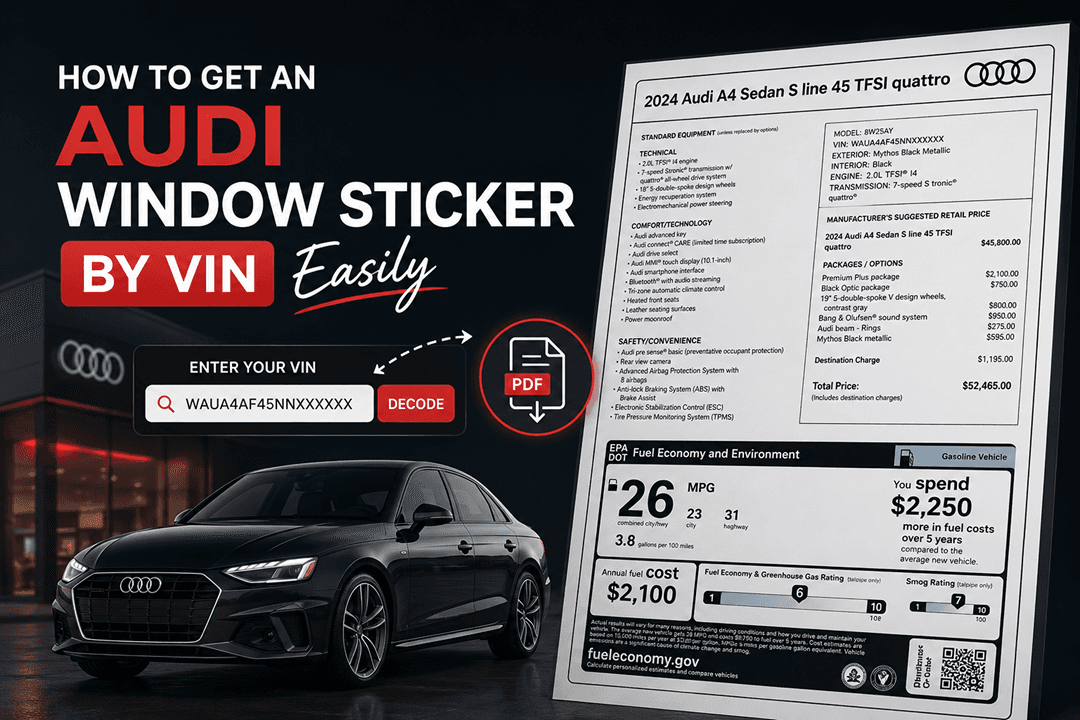
Do you know that you can check the window sticker by using the VIN? Follow these simple steps to get the window sticker in less than a minute.
Step 1: Get the VIN
Ask the seller for the 17-digit VIN. You can find it:
- On the seller’s listing (if provided)
- On the vehicle dashboard (driver’s side, visible through the windshield)
- On the driver’s side door jamb sticker
- Vehicle’s documentation like registration card or the bill of sale
Step 2: Obtain the Window Sticker
Use a service like Audi window sticker to generate a digital replica of the original window sticker using the VIN.
Step 3: Review Information
After you’ve downloaded the window sticker, focus on these critical areas:
Trim Level
- Premium: Entry-level; verify which options are added.
- Premium Plus: Mid-level; check for additional packages.
- Prestige: Top-tier; confirm all expected features are present.
Optional Equipment Section
Look for high-value packages and options:
- Prestige Package
- S line Sport Package
- Driver Assistance Package
- Bang & Olufsen Sound System
- Adaptive Air Suspension
- Sport Differential
Standard Features Section
Understand what comes with the base trim to avoid overpaying for “upgrades” that are actually standard.
MSRP
Note the original total MSRP to understand the vehicle’s original market position.
Step 4: Compare to Seller’s Claims
Create a simple checklist:
| Seller’s Claim | Window Sticker Verification |
|---|---|
| Trim level | ✅ or ❌ |
| S line | ✅ or ❌ |
| Prestige Package | ✅ or ❌ |
| Bang & Olufsen | ✅ or ❌ |
| Quattro AWD | ✅ or ❌ |
| Adaptive cruise | ✅ or ❌ |
← Scroll horizontally to see more →
Step 5: Negotiate or Walk Away
- If the window sticker confirms the seller’s claims and the price is fair, proceed with confidence.
- If the window sticker reveals discrepancies, use them to negotiate a lower price.
- If the vehicle is significantly misrepresented, consider walking away and looking for a better-equipped option.
Real-World Savings Examples
Seeing the numbers in action makes the difference clear. These examples show how checking a window sticker can reveal missing features, pricing gaps, and potential overpricing before you commit.
Example 1: The “Fully Loaded” Premium Plus
| Scenario | Details |
|---|---|
| Seller’s Ad | “2022 Audi Q5 Premium Plus – fully loaded with every option.” |
| Window Sticker Shows | Premium Plus trim with only the Warm Weather Package; no Prestige Package, no Bang & Olufsen, no adaptive air suspension |
| Actual Value Difference | Missing packages valued at approximately $8,000 when new; used value impact of $3,000–$5,000 |
| Savings | Negotiated $4,000 off the asking price using the window sticker documentation |
← Scroll horizontally to see more →
Example 2: The FWD vs Quattro Mistake
| Scenario | Details |
|---|---|
| Seller’s Ad | “2019 Audi A4 Quattro” |
| Window Sticker Shows | Front-wheel drive (FWD) – Quattro was not factory-installed |
| Actual Value Difference | Quattro adds approximately $1,500–$2,500 to the used value |
| Savings | Avoided purchase entirely; found properly equipped A4 Quattro for the same price |
← Scroll horizontally to see more →
Example 3: The Aftermarket S Line Badge
| Scenario | Details |
|---|---|
| Seller’s Ad | “2018 Audi A5 S line – sport appearance package.” |
| Window Sticker Shows | Base Premium trim; no S line package factory-installed |
| Actual Value Difference | The S line package adds $1,000–$2,000 to the used value |
| Savings | Negotiated a $1,500 discount or walked away from an overpriced vehicle |
← Scroll horizontally to see more →
What to Do If the Original Window Sticker is Missing
Most used Audis no longer have the original paper window sticker. Fortunately, you can still obtain a recreated digital window sticker using the VIN.
Recreated Window Sticker Benefits
| Feature | Value to Buyer |
|---|---|
| Same factory data | 100% accurate to the original build |
| Instant delivery | Get it before you make an offer |
| Affordable | Typically lower cost than dealer fees |
| Portable | Digital format easy to share or print |
← Scroll horizontally to see more →
Additional Money-Saving Tips When Buying a Used Audi
Beyond checking the window sticker, there are other ways to reduce costs when buying a used Audi. Taking time to compare listings, review vehicle history, and inspect condition can help you avoid hidden expenses and make a smarter purchase decision.
Use the Window Sticker to Verify Service History Context
While the window sticker doesn’t show service history, it does show original equipment specifications. This helps you:
- Verify that replacement parts match original specifications
- Avoid vehicles with mismatched components that may indicate poor maintenance or accidents
- Ensure any modifications are documented and understood
Combine with Vehicle History Reports
The window sticker is one piece of the puzzle. For complete due diligence, combine it with:
- Vehicle history report: Use the Audi vehicle history report by VIN to check accidents, title issues, and service records.
- Pre-purchase inspection: Professional mechanical inspection.
- Service records: Documented maintenance history.
Consider Long-Term Ownership Costs
The window sticker reveals features that can affect long-term costs. Knowing these factors helps you budget for potential future expenses:
| Feature | Cost Consideration |
|---|---|
| Adaptive Air Suspension | Premium repair cost if components fail |
| Sport Differential | Specialized maintenance requirements |
| Panoramic Sunroof | Potential for leaks or mechanism issues |
| 21” Wheels | Higher tire replacement cost |
| Bang & Olufsen Sound | Expensive amplifier replacement if failed |
← Scroll horizontally to see more →
Frequently Asked Questions
Why is checking a window sticker important when buying a used car?
The window sticker is the only document that shows exactly how the vehicle was configured at the factory—including trim level, factory-installed packages, individual options, and original MSRP. This information helps you verify seller claims, determine fair market value, and avoid overpaying.
Can checking a window sticker really save me money?
Yes. Buyers who check window stickers before purchase commonly save $1,000–$5,000 by:
- Identifying overpriced base models
- Negotiating down when advertised options are missing
- Avoiding vehicles with misrepresented features
- Finding better-equipped vehicles at the same price point
What should I look for on a window sticker when buying used?
Focus on:
- Trim level: Premium, Premium Plus, or Prestige.
- Optional equipment: High-value packages like Prestige Package, S line Sport Package, Driver Assistance Package.
- Individual options: Bang & Olufsen sound, adaptive air suspension, sport differential.
- Drivetrain: Quattro AWD or front-wheel drive.
- Original MSRP: Baseline for depreciation calculations.
What if the seller won’t provide the VIN?
If a seller refuses to provide the VIN, consider it a red flag. A legitimate seller should have no reason to hide the VIN. Without the VIN, you cannot:
- Obtain the window sticker
- Run a vehicle history report
- Verify factory options
Consider walking away and finding a more transparent seller.
Can I get a window sticker for any used Audi?
You can obtain a recreated digital window sticker for most Audi models from 1981 to the present using the VIN. For pre-1981 vehicles or European-spec models, availability may vary.
Is a recreated window sticker as reliable as the original?
For factory-installed information—trim level, packages, options, MSRP—a recreated window sticker from factory records is 100% accurate and contains the same data as the original. The only difference is physical provenance, not data accuracy.
How do I use a window sticker to negotiate a better price?
- Obtain the window sticker before making an offer.
- Compare the factory options to the seller’s claims.
- If options are missing, calculate the value of those options (using original costs and depreciation).
- Present the window sticker to the seller and negotiate based on documented discrepancies.
- Be prepared to walk away if the seller won’t adjust the price to reflect the actual configuration.
What’s the most common way buyers overpay on used Audis?
The most common overpayment is paying Premium Plus or Prestige prices for a base Premium model that lacks desirable packages. Sellers may use terms like “fully loaded” without specifying that the vehicle lacks the Prestige Package, S line package, or other high-value options.
Should I trust a seller who says “all options are factory”?
Always verify with the window sticker. Even honest sellers may not know the full factory configuration of a vehicle they purchased used. The window sticker provides objective documentation.
How does the original MSRP help me save money?
The original MSRP tells you what the vehicle cost when new. By comparing the asking price to the original MSRP and accounting for depreciation, you can determine whether the current price is fair. A vehicle with a higher original MSRP (due to options) should command a higher used price than a base model of the same year and mileage.
Can I use a window sticker to check if a vehicle was in an accident?
No. The window sticker does not show accident history. However, it does show original factory specifications, which can help you identify mismatched components that may indicate prior damage or poor repairs. Always combine the window sticker with a vehicle history report and professional inspection.
What if the window sticker shows options that aren’t on the car?
If the window sticker lists an option that is not present on the vehicle, it could indicate:
- Aftermarket removal: The option was removed after purchase.
- VIN mismatch: The sticker is for a different vehicle.
- Misrepresented vehicle: The seller swapped VIN plates or misrepresented the car.
This is a serious red flag. Verify the VIN matches on the dashboard, door jamb, and window sticker. If discrepancies persist, walk away.